“It came to him suddenly that he was going to win.”

The Swan is the second of four of Roald Dahl’s splendid short stories to be adapted by director Wes Anderson. Bringing together Anderson’s eclectic spirit with Dahl’s imagination and undertones creates a rich adaptation of the story of a young boy just trying to survive his day.
Rupert Friend is the main narrator here, with Ralph Fiennes accompanying to give extra context. Friend describes a day in the life of young Peter, a bird-watcher, whose hobby is not appreciated by the local older boys. They torment Peter mercilessly in a series of scenes set up much like a theatre stage. Brightly coloured crops in the fields juxtapose the dark clothes and melancholic subject matter.
Friend reels off every detail in an extremely childlike manner, directly describing everything being re-enacted around him. Is he embodying the child, or is the description straightforward as though someone were listing off points in a memory for an official record? The answer is soon revealed, adding heightened emotion, and making it clear that this is all spoken from the heart. Much like The Wonderful World of Henry Sugar, this speech pattern sounds more like a recollection in a courtroom than a friendly reminiscence.
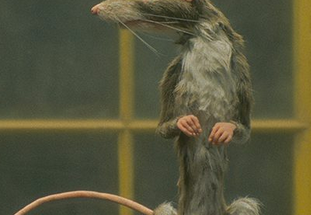
The theatre setup is used repeatedly throughout these adaptations. Stage-hands discreetly move scenery, hand over props, or move characters into position. A stripe of light focussed only on the eyes draws you into the memories. Cut out circles in cardboard are used to replicate views through binoculars. My favourite detail are the puppets; the birds and children are recreated in perfect stop motion detail, including a handheld woodpecker which young Peter holds that actually moves.
The Swan sat in Dahl’s Ideas Book for thirty years before finally being written out properly in October 1976. This new version is a perfect reimaging of the tale of loss and growth.